THE CITY WASN’T BUILT FOR SKATEBOARDING
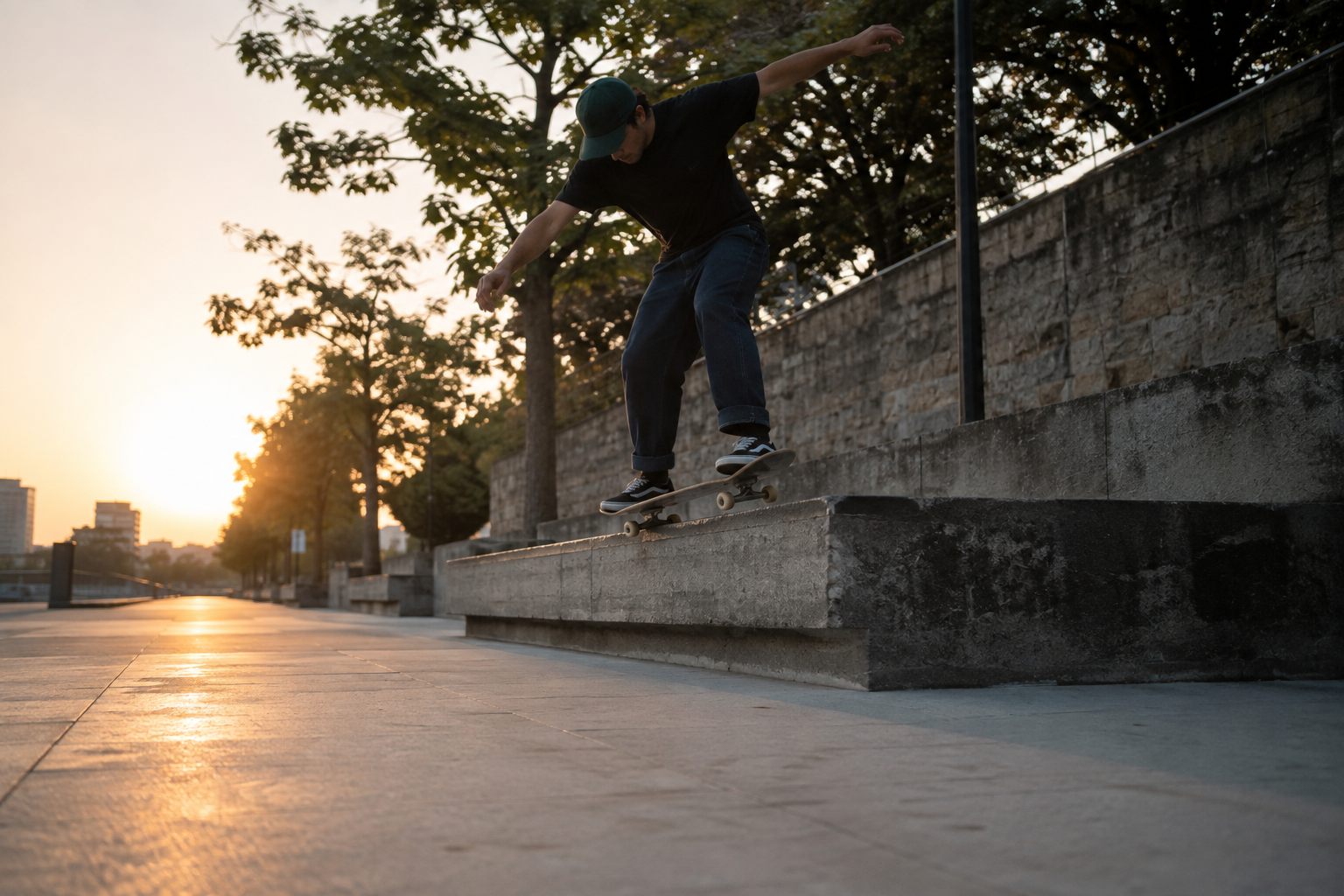
Most of the city wasn’t built with us in mind.
That’s what makes it interesting.
A builder sees a ledge.
An architect sees a wall.
Someone walking to work sees a set of steps they need to get up.
A skateboarder looks at the same place and starts doing the maths.
Is the run-up long enough?
Does the ground roll?
Will that ledge grind?
What happens if you come at it from the other side?
Street skating takes ordinary architecture and gives it another purpose.
Not because somebody told us what it was supposed to be.
Because we looked at it differently.
That mindset goes beyond skateboarding.
You learn pretty quickly that perfect conditions rarely exist.
The ground is rough.
The spot is awkward.
There’s a crack exactly where you don't want one.
You could complain about all of it.
Or you could work it out.
Move your starting point.
Change the angle.
Push harder.
Try something else.
That’s the difference between a skatepark and the street.
A skatepark gives you obstacles.
The street gives you problems.
And solving them is part of the fun.
It’s why a completely ordinary piece of concrete can become important to a group of skaters while everyone else walks past without ever noticing it.
To them, it’s nothing.
To you, it might be the place where you spent three months trying something.
Where your mate finally landed the trick everyone thought was impossible.
Where you met people you still skate with years later.
The city didn’t build that place for you.
You found your own use for it.
Maybe that’s why street skating has always felt different.
It isn't just about what’s there.
It’s about what you can see in it.
ART FIRST. STREETS ALWAYS