Why Skateboarding Is More Than Tricks
Some sessions are about progression.
You finally get the trick you've been battling for weeks. You find a faster line through the bowl. You get comfortable higher up the transition.
Other sessions?
You barely land anything.
And somehow you still leave feeling better than when you arrived.
That side of skateboarding doesn't get talked about enough.
Not the clips.
Not the competitions.
Not who's got the biggest bag of tricks.
Just what happens when you put your board down, push off and, for a while, everything else gets pushed into the background.
Your Brain Has Something Else to Do
Think about what happens when you're carving through a bowl.
You're watching the transition.
Judging your speed.
Thinking about your feet.
Looking for the next wall.
Adjusting your weight.
Preparing for whatever comes next.
There's not much room left for thinking about the crap that was bothering you ten minutes earlier.
We don't want to turn that feeling into some bullshit miracle-health claim. Skateboarding isn't a treatment for depression, anxiety or any other mental-health condition.
But there is genuine research suggesting that skating can have positive social and emotional value.
Skateboard GB says fun and stress reduction are among the main reasons skateboarders report for skating, while also highlighting community, physical activity and mental wellbeing as benefits associated with participation.
That's probably something a lot of skaters recognise without needing a study to tell them.
Sometimes you just need a session.
Failing Is Literally Part of It
Skateboarding has a strange relationship with failure.
You can fail the same trick twenty times.
Then twenty more.
Nobody thinks that's unusual.
That's skating.
The interesting part is what happens next.
You change your feet.
Adjust your speed.
Try a slightly different angle.
Commit a little harder.
And go again.
Research led by Dr Paul O'Connor at the University of Exeter examined the experiences of 30 middle-aged skateboarders. The research found that participants described skateboarding as providing emotional wellbeing, identity and community, with the fluid way skateboarding treats success and failure identified as part of its appeal.
That's one of the things we love about it.
A slam isn't automatically the end of an attempt.
Sometimes it's just information.
Progress Looks Different for Everybody
Skateboarding doesn't have one progression ladder.
Someone's first proper push can matter as much to them as somebody else's first kickflip.
Your first drop-in might be terrifying.
Then eventually it's automatic.
So you move to a bigger ramp.
Then the fear comes back.
That's progression.
Not eliminating fear.
Learning what to do with it.
Skateboard GB's annual report similarly links skateboarding with skills including persistence, commitment, focus, self-awareness and self-control, noting that learning and mastering tricks requires repeated practice.
Nobody gives you those qualities because you bought a skateboard.
You build them.
Usually one failed attempt at a time.
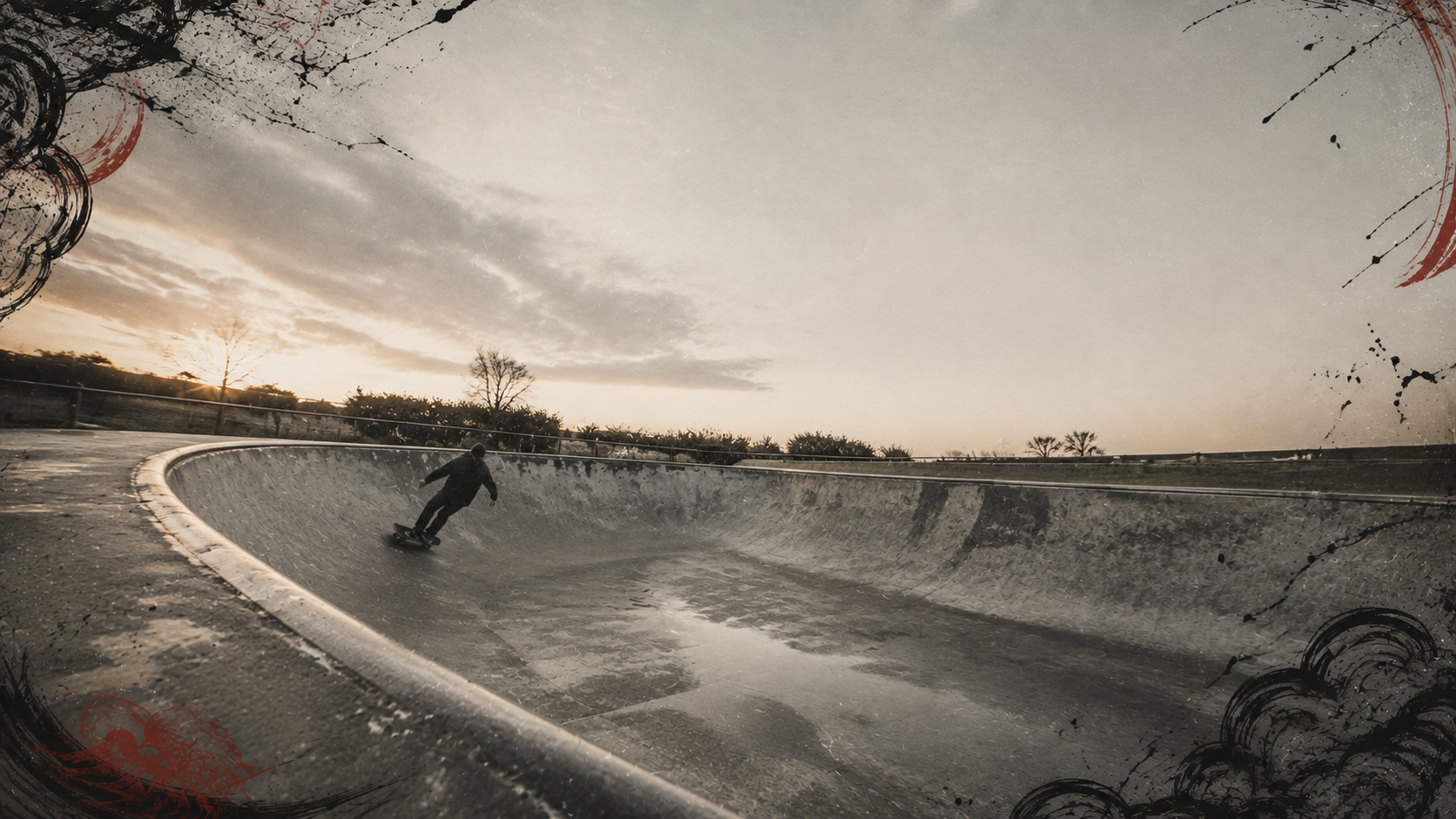
Built for Transition.
Somewhere Between the Drop-In and the Next Wall, Everything Else Goes Quiet.
No pressure. No clip. No proving anything. Just you, your board and the next line..
Then There's the Community
Skateparks are weird places when you think about them.
You can have a 13-year-old learning beside someone who's been skating since before that kid's parents met.
People with completely different jobs, backgrounds and lives can turn up at the same piece of concrete because they share one thing.
They skate.
The UK's first national audit of skateable spaces, conducted during 2025 by Skateboard GB with researchers from Goldsmiths, University of London and skatepark specialists Betongpark, identified approximately 1,923 skateable spaces across the UK. The project specifically examined skateparks not only as physical infrastructure but also for their role in community and social connection.
A good skatepark isn't simply concrete poured into interesting shapes.
It's somewhere people meet.
You Don't Have to Be Young Either
There's still this weird idea that skateboarding is something you're eventually supposed to grow out of.
Apparently nobody told the people still skating.
The Exeter research into middle-aged skateboarders found that some participants had returned to skating through their children, while others had simply never stopped. Participants described social and emotional benefits that went beyond physical exercise.
Bodies obviously change.
Maybe you're not throwing yourself down the same stuff at 45 that you did at 17.
That's fine.
Find a different line.
Skateboarding doesn't have an expiry date printed underneath the deck.
A Session Doesn't Need to Be Productive
This might be the most important part.
Not every session needs content.
You don't need to film everything.
You don't need a new trick.
You don't need to post anything.
You don't even need to skate particularly well.
Sometimes you can just roll around with your mates for an hour.
That's enough.
Because underneath the tricks, clothes, graphics, videos, competitions and everything else surrounding skateboarding, there's still something incredibly simple sitting at the centre of it.
A board.
Somewhere to skate.
And whatever happens after you push off.
Clear your head. Find your line.
Built for Transition.