Skatepark Etiquette: The Unwritten Rules That Keep a Session Flowing
Nobody hands you a rulebook when you first roll into a skatepark.
You turn up with a board, see people flying around everywhere and somehow you're supposed to work out when it's your turn.
Most skaters eventually learn the same way: watching everyone else.
And occasionally getting it completely wrong.
That's part of learning.
But understanding a few basics before you start can make your first sessions considerably better — for you and everybody sharing the park.
First: Learn to Control the Board
Before worrying about dropping into a bowl or hitting coping, get comfortable simply riding.
That isn't us trying to make skateboarding boring.
It's the opposite.
The better you can push, turn and stop, the more of the park eventually becomes available to you.
Skateboard GB takes essentially the same approach with its beginner Cruiser Award: stance, balance, pushing, turning, stopping and safety form the foundation before progression.
There's no shame in spending a session rolling around.
Everybody started somewhere.
Look Before You Go
This might be the most useful habit you can develop.
Before entering an obstacle or bowl, look.
Someone could already be halfway through a line that brings them straight towards where you're about to skate.
Transition makes this especially important.
A bowl isn't just the bit immediately in front of somebody. A skater can travel through several sections during a single line.
Watch for a moment.
You'll start seeing the pattern.
Who's skating?
Where are they starting?
Where are their lines taking them?
Then take your opportunity.
Don't Snake People
You'll hear the word eventually.
Snaking basically means cutting into somebody else's turn or line.
Sometimes beginners do it accidentally because they haven't learnt the rhythm of a busy park yet.
Nobody sensible expects a new skater to understand everything immediately.
But once you know, pay attention.
If somebody has clearly been waiting and is preparing to go, don't suddenly launch yourself in front of them because you spotted a two-second gap.
Wait.
Your turn is coming.
Don't Sit on Obstacles
A ledge might look like a perfect bench.
Unfortunately, somebody might also be trying to skate it.
The same applies to sitting on coping, standing at the bottom of a transition or leaving bags and bottles around skateable areas.
Find somewhere out of the main lines.
Skateparks aren't only collections of isolated obstacles. Skateboard GB's facilities guidance describes Street, Transition and Flow as the three main terrain types typically incorporated into parks.
That means the empty-looking bit you're standing on might actually connect two features in somebody else's line.
You Don't Need to Be Good to Belong There
This one matters.
A skatepark isn't reserved for people who can already skate well.
Skateboard GB explicitly describes skateparks as places where skateboarders can learn and develop skills, as well as spaces for exercise, creativity and socialising.
If you're learning to push while somebody else is blasting airs out of the deep end, both of you have a legitimate reason to be there.
Ability isn't the issue.
Awareness is.
You can be a complete beginner and still be good to skate with.
Give Beginners Some Room
This works both ways.
Experienced skaters usually have much better awareness of what's happening around them.
Beginners don't.
They're concentrating on approximately seventeen things at once.
Where are my feet?
Why is the board moving that way?
Am I going too fast?
How do I stop?
Why did I think skateboarding looked easy?
If somebody is obviously learning, give them some space.
Skateboarding grows when new people feel able to participate rather than feeling like they're trespassing.
Don't Turn Every Session Into a Competition
Progression is part of skating.
So is doing absolutely nothing impressive for an afternoon.
You don't have to prove yourself every time somebody better turns up.
Watch them.
Learn.
Ask questions if the moment feels right.
Then skate at your own level.
Ironically, trying desperately to impress everybody is probably more noticeable than simply getting on with skating.
Respect Different Wheels
Modern skateparks aren't exclusively occupied by skateboarders.
Skateboard GB notes that parks commonly accommodate skateboards alongside BMX bikes, scooters, roller skates, adapted wheelchairs and other wheeled users.
That can obviously create friction.
Different disciplines move differently and use obstacles differently.
But shouting at a ten-year-old because they're riding a scooter isn't skate culture.
It's just being a dick to a ten-year-old.
Watch each other's lines.
Communicate.
Share the space.
Don't Trash the Place
This shouldn't require explaining.
Take your rubbish with you.
Don't smash glass anywhere near somewhere people are skating.
Don't deliberately damage obstacles.
And don't assume somebody else will clear up after you.
Good skateparks aren't guaranteed.
Building them involves consultation, location decisions, design, planning, funding, construction and safety inspection. Skateboard GB's facilities guidance makes clear how substantial that process can be.
Treat the places we've got like they're worth keeping.
Because they are.
The Actual Rule Is Pretty Simple
You could probably reduce most skatepark etiquette to four words:
Pay attention. Respect people.
Learn how the park flows.
Wait for your turn.
Don't block people's lines.
Help somebody up when they slam.
Move your stuff out of the way.
And remember that the kid wobbling around the shallow end today might be absolutely destroying that same bowl in five years.
Skateboarding has always had its own culture.
The good parts of that culture aren't about deciding who gets to belong.
They're about sharing a session.
Find your line. Respect theirs.
Built for Transition.
Sources
Make it stand out
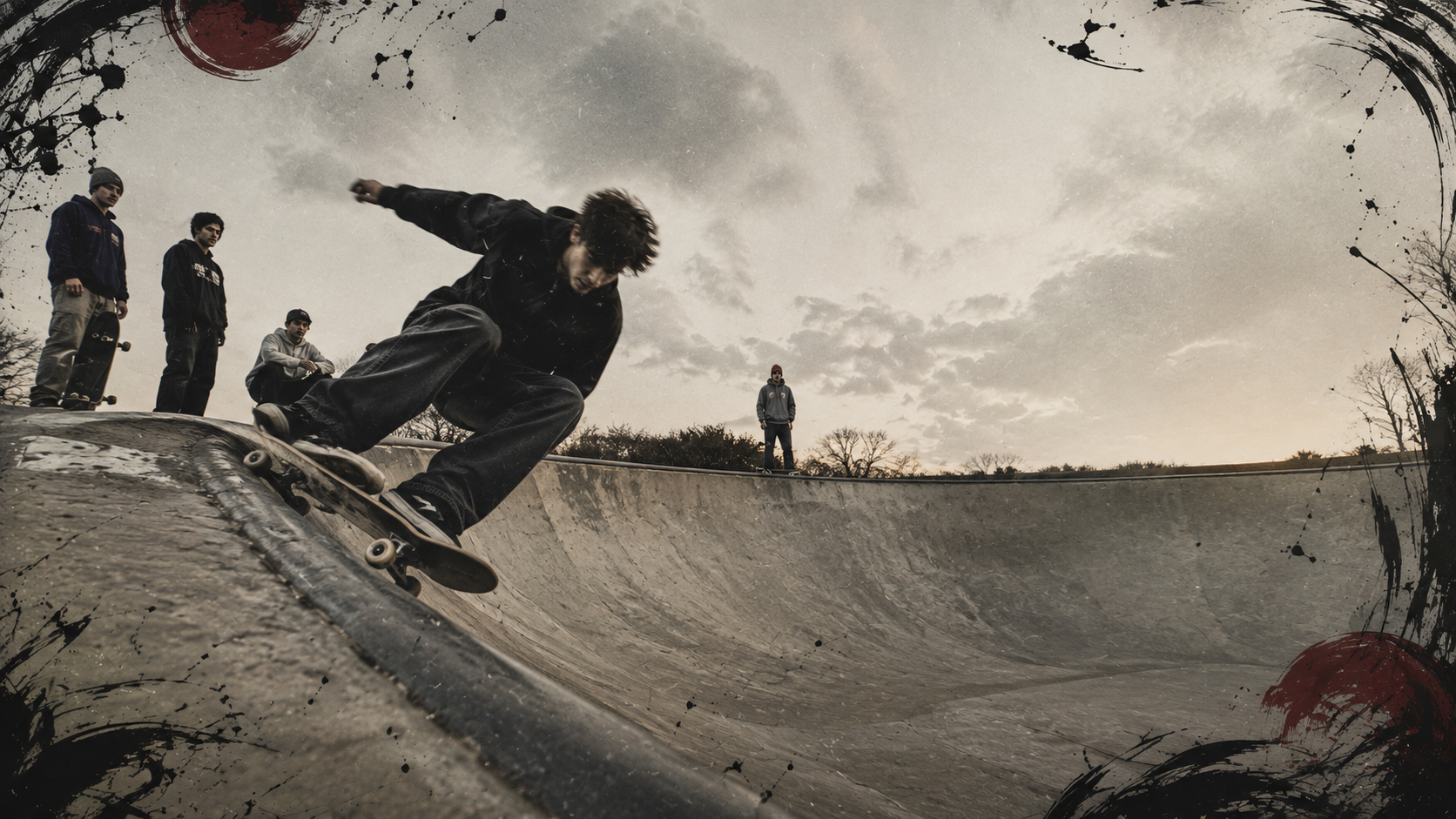
A gritty, wide-angle photograph of a skateboarder carving through a worn concrete bowl while other skaters wait along the edge. Shot from low inside the bowl beneath a cloudy British sky, with weathered concrete, natural film grain and subtle black and dark-red Japanese-inspired ink details framing the scene.