Why Transition Skating Still Hits Different
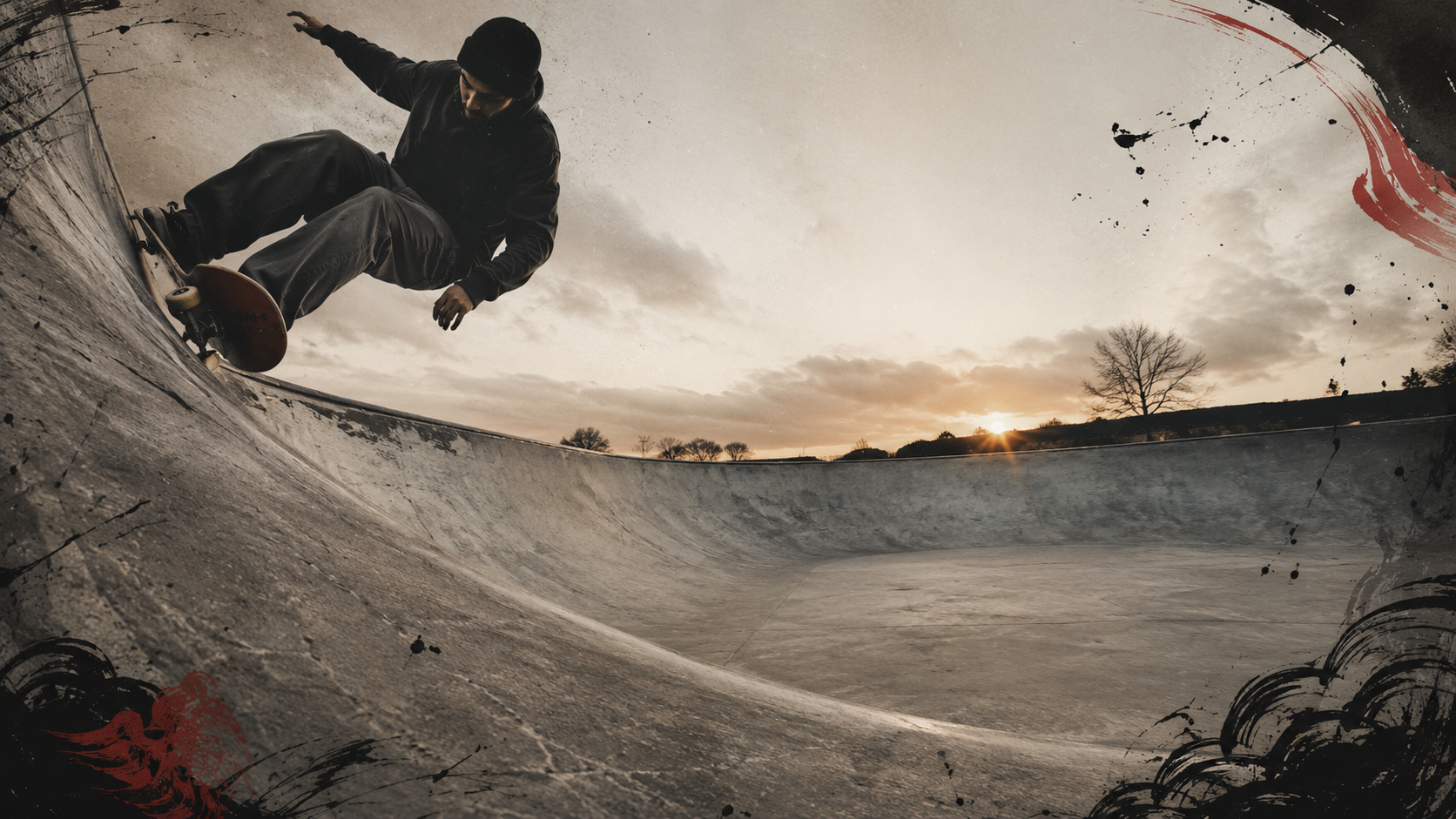
There’s something different about dropping into a ramp.
Street skating lets you look at the world and find something skateable in places that were never designed for a skateboard. Transition gives you something else: speed, lines and flow.
You’re not just trying to land a trick.
You’re trying to keep moving.
So, What Actually Is Transition?
Transition skating is built around curved terrain: quarter pipes, bowls, mini ramps, vert ramps, hips and other features that take you from horizontal towards vertical.
Skateboard GB’s skatepark guidance divides skatepark terrain into three broad categories: Street, Transition and Flow.
That distinction matters.
On transition, the ramp itself becomes part of the trick. How much speed you carry, where you pump, where you turn and how you approach the coping can completely change a line.
A good run can look almost effortless.
It isn’t.
It Goes Back a Long Way
Transition isn’t some new competition format created for modern skateparks.
Its roots run deep.
Skateboarding developed in the United States around the late 1950s, heavily influenced by surfing. The arrival of polyurethane wheels in the 1970s helped transform what skateboards could be ridden on, while purpose-built concrete skateparks began appearing in the US from 1976.
Those early parks borrowed ideas from the environments skaters were already attacking.
Swimming pools became bowls.
Drainage structures influenced skatepark shapes.
Surfing influenced flowing walls and snake runs.
And the half-pipe eventually became one of skateboarding’s most recognisable structures.
Britain was part of that story too. Commercial skateparks appeared across the UK during 1977 and 1978, including places such as Rom in Essex, Harrow, Southsea and Livingston.
Many disappeared within only a few years.
The skating didn’t.
When skateboarding's popularity declined around the beginning of the 1980s, dedicated skaters continued riding the surviving parks and standalone wooden half-pipes.
That matters because skate culture has never survived purely because something was fashionable.
People kept skating because they wanted to skate.
Transition Isn't Just Vert
Mention ramp skating and people sometimes picture somebody flying metres above a massive half-pipe.
That’s vert.
But transition is much broader.
A small quarter pipe can teach you how to pump.
A mini ramp can teach you how to work with coping.
A bowl can force you to think about lines rather than isolated tricks.
A hip can completely change the direction of a run.
You don't need to be twelve feet in the air to understand why transition is addictive.
Sometimes linking three corners cleanly feels better than forcing the biggest trick you know.
Flow Matters
This is probably the biggest difference.
On a street obstacle, you can repeatedly approach the same rail, stair set or ledge and work on one trick.
Transition doesn't always give you that luxury.
Lose your speed in one corner and the next part of the line changes.
Take the wrong angle and suddenly you're fighting the ramp rather than using it.
That's why experienced transition skaters can make relatively simple tricks look so good.
They're not only controlling the skateboard.
They're controlling momentum.
Park Skateboarding Put Transition on a Global Stage
Modern Olympic skateboarding has two disciplines: Street and Park.
Park competition takes place on hollowed-out courses with steep transitioned walls. Skaters use the entire course for airs, spins, grinds and other tricks while building creative runs.
That has put transition skating in front of an enormous international audience.
But competition is only one part of skateboarding.
For most of us, skating isn't about judges.
It's about finally committing to the drop-in you've been staring at.
It's about hearing your wheels accelerate through a transition.
It's about getting your first axle onto coping.
And then immediately wanting another go.
Britain Still Needs Good Skate Spaces
There is some encouraging news.
Skateboard GB's first national audit of skateable spaces, conducted during 2025 with researchers from Goldsmiths, University of London and skatepark specialists Betongpark, identified approximately 1,923 skateable spaces across the UK.
The research also found something important: simply having a skatepark isn't enough.
Design matters.
Location matters.
Construction matters.
Flow matters.
And the people using the place matter.
That makes sense to anyone who actually skates.
Two parks can contain roughly the same number of obstacles and feel completely different underneath your wheels.
Why We Keep Coming Back to Ramps
At Oni Ramp, we're obviously biased towards transition.
It's in the name.
But there's a reason ramps became part of the identity.
Transition strips skateboarding down to something incredibly simple:
board, speed, concrete and commitment.
You can spend years learning tricks and still find a completely new line through a bowl you've ridden hundreds of times.
That's the part we love.
Not chasing whatever happens to be fashionable this month.
Not pretending skateboarding has to look one particular way.
Just riding.
Finding your line.
And when you reach the bottom?
Pump harder and go again.
Built for Transition.